
World’s tallest 3D-printed building completed in the Swiss Alps
Updated: Jul 31, 2025
The tallest 3D-printed building in the world has been completed in Switzerland. Named Tor Alva (The White Tower) and located in the alpine village of Mulegns, the project was undertaken by the Origen Cultural Foundation in collaboration with ETH Zurich to understand the relationship between digital fabrication, cultural heritage preservation, and rural revitalization.
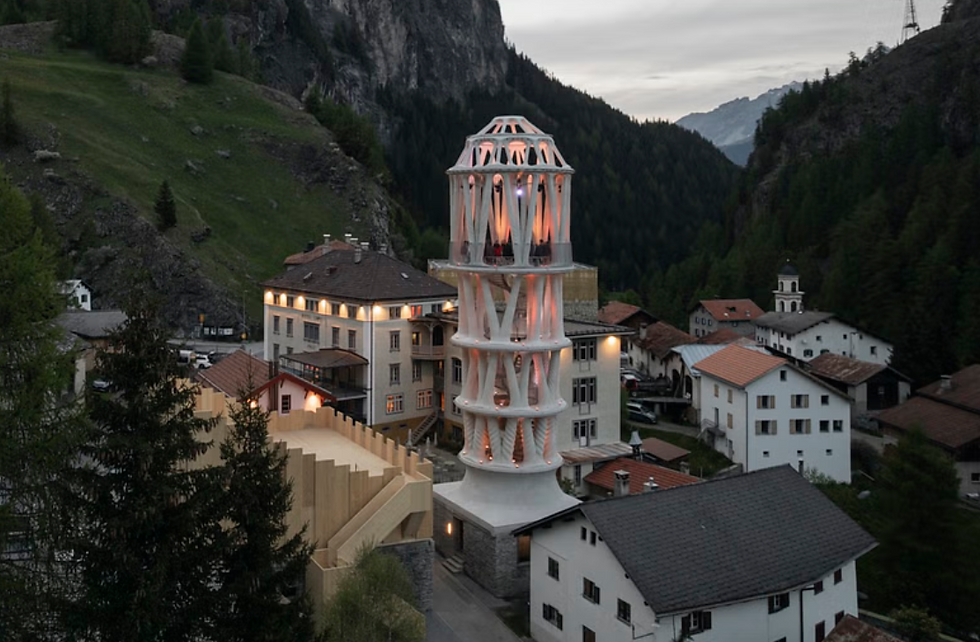
The five-story tower’s defining feature is its 32 unique, load-bearing 3D-printed concrete columns. The Y-shaped columns contain intricate detailing at three distinct scales, made possible by a novel fabrication process involving two cooperating robots, with one extruding concrete while the other places steel reinforcement.

Meanwhile, the interior is composed of vertically stacked rooms accessed via a spiral staircase, transitioning from enclosed spaces at the base to a light-filled dome at the top. The environment has previously been described by the team as “abstract, atmospherically dense spaces” that “range from dark and enclosed rooms at the bottom to light and airy ones on top.”

Beyond technical innovation, Tor Alva aims to revive the dwindling village of Mulegns, whose population has dropped to just 12 residents. Built atop a restored historic carriage depot, the tower forms part of a broader initiative that includes the relocation of a protected villa and the reopening of a historic hotel. Through cultural programming and architectural tourism, the project seeks to propel economic renewal.

“The project serves a dual purpose: to create a one-of-a-kind performance space that merges architecture, culture, and science, while also revitalizing a village confronting structural challenges,” the team notes. “Additionally, it showcases the interdisciplinary research from ETH Zurich, advancing digital building practices that foster innovative, rich, and sustainable environments.”

Environmental performance is also central to the project. The formwork-free method reduces material use by 40%, and the structure incorporates stainless steel to safely support carbonation, allowing the building to recapture carbon dioxide over time. Ongoing monitoring of carbon uptake aims to inform future sustainable design practices.


Comments