
Ten years after a slow start, what is the current state of 3D building printing?
Robot-built houses and small buildings are struggling to become more widely available, not least because they are still more expensive than conventional buildings. But new technologies are opening up new prospects.
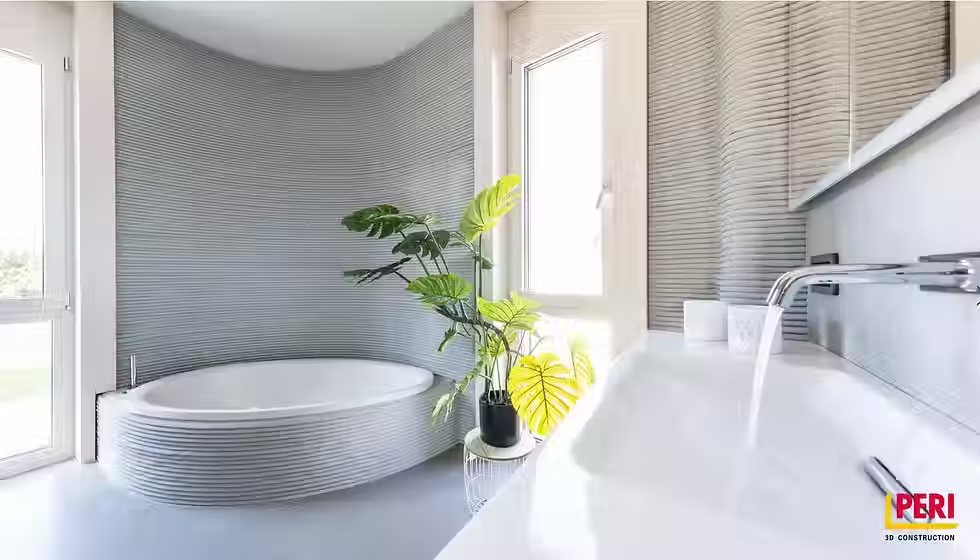
The bathroom of a house printed in concrete by Peri3D, in Beckum, Germany. PERID3D CONSTRUCTION GMBH
Ten years ago, the first printed concrete houses saw the light of day, built by large robots similar to those used in car factories, or by motorised gantries - a giant version of domestic 3D printers. At the time, the promoters of this technology were convinced that it would bring down the price of buildings, speed up construction and offer great architectural freedom. But ten years on, the revolution has yet to materialise. "It's likely that fewer than fifty buildings have been printed in Europe," says Lukas Bischofberger, Marketing Manager at Peri3D, which has built around ten of them.
You can share an article by clicking on the share icons in the top right-hand corner. Reproduction of all or part of an article without the prior written permission of Le Monde is strictly prohibited.
For further information, please consult our general terms and conditions of sale. As a subscriber, you can offer up to five articles per month to one of your friends or family thanks to the "Offer an article" feature.
In terms of architectural freedom, it's true that the technology makes it possible to produce rounded walls that enhance the pleasure and well-being of occupants. For the rest, the other promises are slow to materialise. "Printing is still more expensive than traditional construction techniques," says Jérôme Florentin, Project Management Director at Plurial Novilia.
In Bezannes, in the Marne region of France, the construction company has started work on a building for private individuals, at a relatively moderate cost in relation to its energy requirements (REC2025 standard). "We're budgeting €3,000 per square metre, compared with €2,300 for an equivalent building constructed using traditional methods," explains Jérôme Florentin.
By Nicolas Six


Comments